
DOSERANK guide
Glycine Dosage: Evidence-Based Guide for 2026
Published
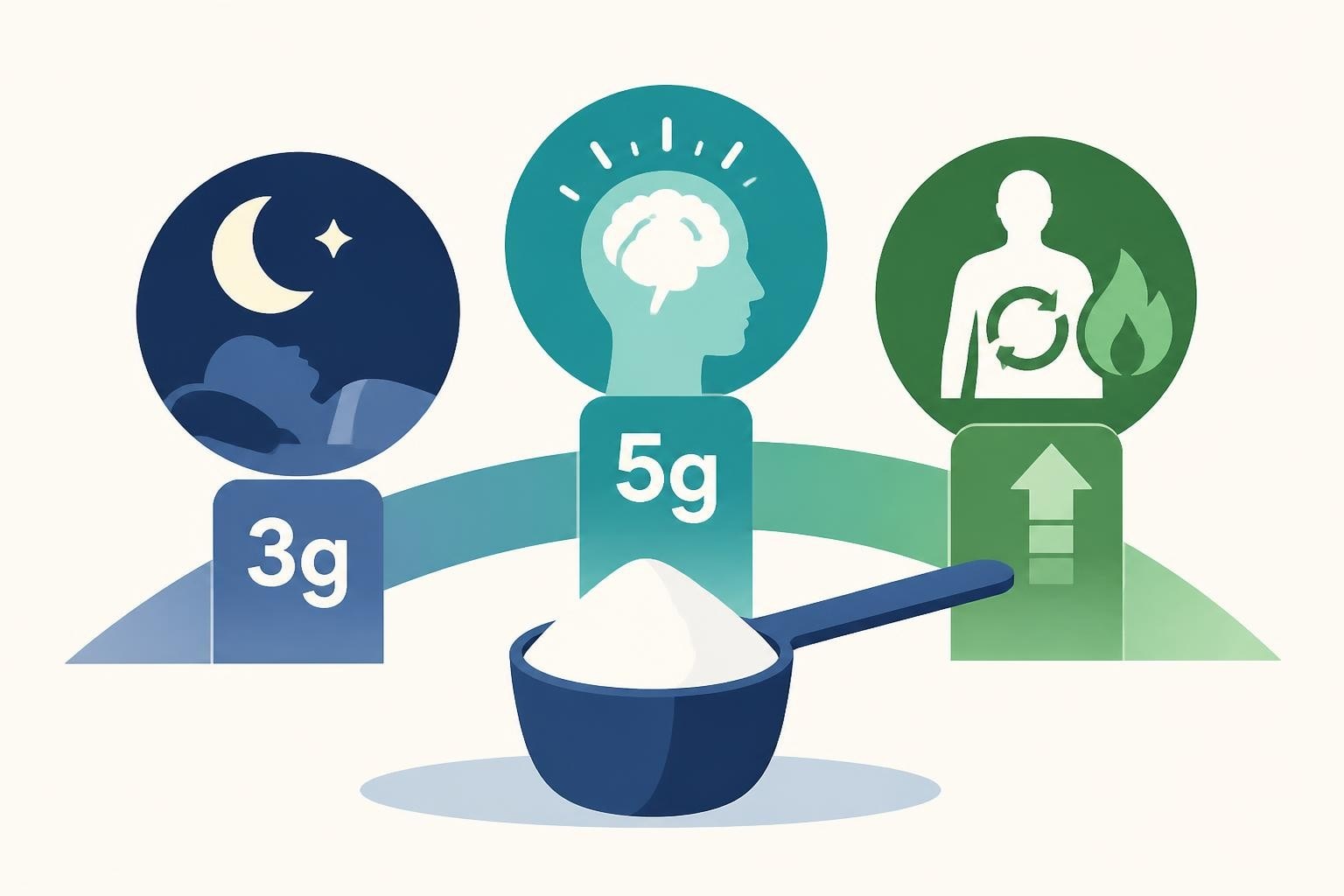
Glycine has emerged as one of the most versatile amino acids in the supplement landscape, supporting everything from sleep quality to metabolic health. Unlike many supplements where dosing remains unclear, glycine benefits from decades of clinical research establishing clear dose-response relationships across multiple health outcomes. Understanding the right glycine dosage for your specific goals requires examining both the scientific evidence and practical considerations around timing, form, and individual response patterns.
Understanding Glycine and Its Therapeutic Range
Glycine functions as both a neurotransmitter and a building block for proteins, collagen, and other critical compounds throughout the body. This dual role explains why effective doses span such a wide range depending on the intended outcome.
The body produces glycine endogenously, but emerging research suggests that endogenous production may not meet optimal levels for certain therapeutic applications. Supplemental doses typically range from 3 grams to 15 grams daily, far exceeding the amounts found in typical diets. This gap between dietary intake and therapeutic doses underscores why supplementation has gained traction.
Baseline Production and Dietary Context
Your body synthesizes approximately 2-3 grams of glycine daily from other amino acids, primarily serine. Dietary sources contribute another 1.5-3 grams for most people, depending on protein intake and food choices. Collagen-rich foods like bone broth, skin-on poultry, and gelatin provide the highest concentrations.
Research indicates that total glycine availability (endogenous plus dietary) may fall short of amounts needed for optimal collagen synthesis, detoxification, and neurological function. Clinical evidence suggests that supplemental doses address this gap effectively across various health contexts.

Evidence-Based Dosing by Health Goal
Different therapeutic applications require distinct glycine dosage protocols. The following breakdown reflects current clinical evidence and practical usage patterns observed in 2026.
Sleep Quality and Architecture
Standard dose: 3 grams taken 30-60 minutes before bedtime
Multiple placebo-controlled trials have established 3 grams as the effective dose for sleep enhancement. This amount has demonstrated improvements in subjective sleep quality, reduced sleep latency, and enhanced next-day alertness. Participants report feeling more rested without experiencing next-day grogginess.
Sleep research shows that glycine works primarily by lowering core body temperature and modulating NMDA receptor activity in the suprachiasmatic nucleus. The 3-gram threshold appears necessary to achieve meaningful thermoregulatory effects. For those specifically interested in optimizing sleep, platforms like DoseRank evaluate supplements based on evidence-backed dosing protocols matched to individual sleep goals.
Cognitive Function and Mental Clarity
Standard dose: 5-10 grams daily, often split into two doses
Higher doses support cognitive performance through glycine's role as an inhibitory neurotransmitter and co-agonist at NMDA receptors. Studies examining cognitive benefits typically employ 5-10 grams daily, with some protocols splitting this into morning and afternoon doses.
- Schizophrenia research uses 15-60 grams daily as adjunct therapy
- Cognitive enhancement studies typically use 5-10 grams
- OCD trials have tested 60 grams daily in divided doses
These clinical ranges demonstrate glycine's safety profile while highlighting that cognitive applications often require higher amounts than sleep support. Evidence-based guidance suggests starting at the lower end and titrating upward based on response.
Metabolic and Collagen Support
Standard dose: 10-15 grams daily
Metabolic health applications and collagen synthesis support generally require sustained higher doses. Research on glucose metabolism, insulin sensitivity, and cardiovascular markers typically employs 10-15 grams daily.
For collagen production specifically, the body requires substantial glycine amounts since this amino acid constitutes roughly one-third of collagen's structure. While collagen supplements provide glycine, direct supplementation offers a concentrated source.
| Health Goal | Daily Dose | Timing | Evidence Level |
|---|---|---|---|
| Sleep quality | 3g | Before bed | Strong |
| Cognitive support | 5-10g | Split doses | Moderate |
| Metabolic health | 10-15g | With meals | Emerging |
| Collagen synthesis | 10-15g | Throughout day | Moderate |
| Athletic recovery | 5-10g | Post-exercise | Preliminary |
Timing and Administration Strategies
When you take glycine matters nearly as much as how much you take. The amino acid's half-life and mechanism of action inform optimal timing protocols.
Pre-Sleep Administration
For sleep applications, consistency matters more than precision. Research on sleep dosing indicates that taking 3 grams within the hour before bed produces reliable results. Some users report better outcomes when taken 60-90 minutes before sleep, potentially allowing more time for absorption and thermoregulatory effects to initiate.
Taking glycine with a small amount of carbohydrate may enhance absorption, though this hasn't been formally tested in sleep studies. Most trials used glycine dissolved in water on an empty stomach.
Divided Dosing for Higher Amounts
When glycine dosage exceeds 5 grams daily, splitting the total into 2-3 doses throughout the day improves tolerability and may enhance effectiveness. This approach prevents digestive discomfort while maintaining steady plasma levels.
Example protocol for 10g daily:
- 3-4 grams with breakfast
- 3-4 grams with lunch or post-workout
- 3 grams before bed
This distribution supports both daytime cognitive function and nighttime sleep quality while minimizing gastrointestinal effects.

Form, Quality, and Absorption Considerations
Not all glycine supplements deliver equivalent results. Form and quality significantly impact bioavailability and practical usage.
Powder Versus Capsules
Glycine powder offers the most cost-effective and flexible option, particularly for doses above 3 grams. A typical capsule contains 500-1000mg, meaning 6-10 capsules would be needed for basic sleep dosing.
Powder advantages:
- Precise dose adjustment
- Lower cost per gram
- Easier consumption at higher doses
- Dissolves readily in water or beverages
Capsule advantages:
- Convenient for travel
- Pre-measured doses
- No taste considerations
- Better for doses under 2 grams
The powder form dominates clinical research because precise dosing becomes critical in controlled trials. Dosage calculators can help determine exact amounts needed based on individual factors.
Purity and Third-Party Testing
Pure glycine powder should contain minimal excipients or additives. Look for products listing "glycine" or "aminoacetic acid" as the sole ingredient. Third-party testing for heavy metals, microbial contamination, and stated purity helps ensure product quality.
Pharmaceutical-grade glycine typically exceeds 99% purity, while supplement-grade products may range from 95-99%. This difference rarely impacts effectiveness at standard doses but becomes relevant at higher therapeutic amounts.
Safety Profile and Side Effect Management
Glycine demonstrates remarkable safety even at doses far exceeding typical supplementation ranges. Understanding the complete safety picture helps inform appropriate dosing decisions.
Established Safety Data
Human studies have administered up to 90 grams daily for weeks without serious adverse events. The most common side effects at high doses include mild gastrointestinal discomfort, nausea, and soft stools. These effects typically resolve with dose reduction or divided administration.
Reported side effects by dose:
- 3g daily: Minimal to none in most users
- 5-10g daily: Occasional mild GI symptoms
- 15-30g daily: More frequent digestive effects
- 60g+ daily: Regular GI symptoms, occasional vomiting
Most users tolerate standard glycine dosage ranges (3-10g) exceptionally well. The amino acid's role as a natural body constituent contributes to this favorable safety profile.
Individual Variation and Titration
Starting with lower doses and gradually increasing allows assessment of individual tolerance and response. Some people report noticeable sleep benefits at 1.5-2 grams, while others require the full 3-gram dose.
Begin with 1-2 grams and increase by 1 gram every 3-5 days until reaching your target dose or experiencing desired effects. This conservative approach minimizes side effects while identifying your optimal amount.
Special Populations and Considerations
Certain groups require modified dosing approaches or additional precautions when using glycine supplementation.
Pregnancy and Breastfeeding
Limited data exists on glycine supplementation during pregnancy and lactation. While glycine itself is essential for fetal development, supplemental doses haven't been adequately studied in pregnant populations. Conservative medical opinion suggests avoiding doses exceeding 3 grams during pregnancy without medical supervision.
Renal Function Concerns
Individuals with compromised kidney function should exercise caution with amino acid supplementation. Though glycine doesn't accumulate dangerously in most cases, higher doses may stress already-compromised renal clearance mechanisms. Medical supervision becomes particularly important for doses exceeding 5 grams daily.
Medication Interactions
Glycine's NMDA receptor activity theoretically could interact with psychiatric medications, particularly those affecting glutamate signaling. Known interaction considerations:
- Clozapine: Glycine may reduce effectiveness
- Antipsychotics: Potential adjunctive benefits but requires monitoring
- Benzodiazepines: Additive sedative effects possible
- Anticoagulants: No known interactions but theoretical concerns exist
Consult healthcare providers before combining glycine with prescription medications, particularly psychiatric drugs.

Optimizing Response and Measuring Effectiveness
Determining whether your chosen glycine dosage works effectively requires clear metrics and adequate trial duration.
Timeframe for Expected Results
Sleep applications: Most users notice improvements within 3-5 days, with full effects emerging after 1-2 weeks of consistent use. Detailed therapeutic guidance suggests allowing at least one week before adjusting doses.
Cognitive effects: Subjective improvements may appear within days, but cognitive testing shows maximal benefits after 2-4 weeks at consistent doses.
Metabolic markers: Blood glucose, lipid panels, and other metabolic measures typically require 4-8 weeks to show significant changes.
Tracking and Adjustment
Maintain a simple log noting your dose, timing, and subjective outcomes. For sleep, track:
- Time to fall asleep
- Number of nighttime awakenings
- Morning grogginess levels
- Overall sleep satisfaction (1-10 scale)
This data helps identify whether dose adjustments might improve results. Platforms like DoseRank incorporate evidence-based outcome tracking into their methodology, helping users evaluate supplement effectiveness systematically.
Cost-Effectiveness Across Dose Ranges
Glycine stands out for exceptional value compared to many specialized sleep or cognitive supplements. Understanding cost-per-dose helps inform purchasing decisions.
Price Comparison by Form and Brand
Bulk glycine powder typically costs $15-30 per kilogram, translating to roughly $0.05-0.10 per 3-gram dose. Capsule forms generally cost 2-3 times more per gram due to encapsulation expenses.
| Form | Typical Cost per 3g Dose | Annual Cost (Daily Use) |
|---|---|---|
| Bulk powder | $0.05-0.10 | $18-36 |
| Mid-tier powder | $0.15-0.25 | $55-90 |
| Capsules | $0.30-0.50 | $110-180 |
| Premium capsules | $0.50-0.80 | $180-290 |
These figures assume standard 3-gram sleep dosing. Higher therapeutic doses proportionally increase costs but maintain glycine's value advantage over specialized formulations.
Combining Glycine With Other Supplements
Many users incorporate glycine into broader supplementation protocols. Understanding synergies and potential redundancies optimizes overall approaches.
Sleep Stack Combinations
Glycine pairs well with other evidence-based sleep supplements without significant interaction concerns:
- Magnesium glycinate: Provides both glycine and magnesium for sleep support
- L-theanine: Complementary mechanisms without redundancy
- Melatonin: Different timing (melatonin earlier, glycine closer to bed)
When using magnesium glycinate, account for the glycine content in your total daily glycine dosage, though the amount per typical magnesium dose remains modest (under 1 gram).
Collagen and Amino Acid Protocols
If taking collagen supplements primarily for glycine content, note that collagen provides roughly 20-25% glycine by weight. A 10-gram collagen dose delivers approximately 2-2.5 grams of glycine, which may partially satisfy sleep dosing needs but falls short of higher therapeutic targets.
Direct glycine supplementation offers more precise control and higher concentrations than collagen-based approaches.
Emerging Research and Future Directions
Scientific understanding of optimal glycine dosage continues evolving. Several research directions may refine current recommendations.
Personalized Dosing Approaches
Preliminary evidence suggests genetic variations in glycine metabolism might influence optimal doses. Future protocols may incorporate genetic testing to identify individuals requiring higher or lower amounts for equivalent effects.
Body weight correlations remain unclear in current research. Unlike many drugs, glycine studies haven't established weight-based dosing, though some practitioners extrapolate from clinical trials using fixed doses across varied populations.
Novel Delivery Methods
Sustained-release formulations could potentially reduce the frequency of divided dosing for higher therapeutic amounts. Time-release glycine remains largely unexplored but represents a logical development for doses exceeding 10 grams daily.
Sublingual and transdermal delivery methods haven't gained traction due to glycine's high water solubility and excellent oral bioavailability. These alternative routes appear unnecessary given current absorption efficiency.
Practical Implementation Guide
Translating research into daily practice requires clear, actionable steps. The following protocol works for most people seeking sleep or general wellness benefits.
Week 1-2: Begin with 2 grams before bed, dissolved in water 30-60 minutes prior to sleep. Monitor sleep quality and any digestive responses.
Week 3-4: Increase to 3 grams if initial response proves insufficient. Maintain consistent timing to establish routine.
Week 5+: If pursuing cognitive or metabolic goals, consider adding a 2-3 gram morning dose while maintaining evening dose. Assess overall response before further increases.
For higher therapeutic doses beyond 5 grams daily, medical supervision provides additional safety assurance and helps monitor relevant biomarkers.
Determining the right glycine dosage depends on your specific health goals, tolerance, and response patterns, with evidence supporting ranges from 3 grams for sleep to 15 grams for metabolic applications. Rather than navigating dosing decisions alone, DoseRank evaluates supplements based on evidence-backed dosing protocols, trust factors, and value considerations, helping you identify products that match your needs. The platform's systematic approach to ranking supplements ensures you're choosing options with appropriate doses backed by clinical research.