
DOSERANK guide
Best Quality Supplements: A Complete Buying Guide 2026
Published

The supplement industry generated over $50 billion in revenue in 2025, yet the average consumer faces a bewildering array of choices with little reliable guidance. Unlike pharmaceutical drugs, dietary supplements enter the market without pre-approval for safety or efficacy, creating a landscape where quality varies dramatically between brands and even between batches. Understanding what separates the best quality supplements from inferior products requires examining multiple dimensions, from ingredient sourcing and manufacturing practices to scientific evidence and third-party verification. This comprehensive guide will equip you with the knowledge to make informed decisions when selecting supplements for your health goals.
The Six Pillars of Supplement Quality
Evaluating supplement quality demands a systematic framework that goes beyond marketing claims and attractive packaging. The best quality supplements excel across multiple dimensions simultaneously, creating a comprehensive profile of trustworthiness and effectiveness.
Evidence-Based Formulation
Scientific validation stands as the foundation of quality supplementation. Products backed by robust human clinical trials demonstrate not just theoretical benefits but actual measurable outcomes in real-world populations. The best quality supplements contain ingredients with published research showing efficacy at the specific doses included in the formulation.
Key evidence markers include:
- Randomized, placebo-controlled trials published in peer-reviewed journals
- Sample sizes large enough to detect meaningful effects
- Study populations matching your demographics and health status
- Replication of findings across multiple independent research groups
- Transparent reporting of both positive and negative outcomes
Many supplement manufacturers reference studies conducted with completely different doses, forms, or even different ingredients altogether. This practice, sometimes called "label dressing," creates the illusion of scientific support without actual relevance to the product you're purchasing.

Dose Fit and Bioavailability
A supplement containing the "right" ingredient proves worthless if the dose falls below the therapeutic threshold established in research. The best quality supplements match or exceed the doses shown effective in clinical trials while remaining well below upper safety limits.
| Dose Consideration | Poor Quality | High Quality |
|---|---|---|
| Active ingredient amount | Below effective threshold | Matches clinical research |
| Form of ingredient | Cheapest available | Bioavailable, well-absorbed |
| Dosing frequency | Once daily regardless of half-life | Matches pharmacokinetics |
| Cofactors included | Absent | Present when synergistic |
Bioavailability determines how much of an ingested nutrient actually reaches your bloodstream and tissues. Magnesium oxide costs less than magnesium glycinate, but your body absorbs the latter far more efficiently. Curcumin requires piperine or special delivery systems to achieve meaningful absorption. The best quality supplements invest in forms that your body can actually utilize.
Manufacturing Standards and Certifications
Production quality directly impacts both safety and efficacy. Manufacturing facilities operating under current Good Manufacturing Practices (cGMP) follow standardized protocols for everything from raw material verification to finished product testing. These practices minimize contamination risks and ensure batch-to-batch consistency.
Essential certifications to look for:
- NSF International certification (NSF/ANSI 173)
- United States Pharmacopeia (USP) Verified Mark
- Informed Sport or Informed Choice (for athletes)
- Non-GMO Project Verified
- Organic certifications (USDA, EU organic)
According to systematic research on supplement adulteration, undeclared pharmaceutical ingredients and prohibited substances appear far more frequently than most consumers realize. Third-party testing provides an additional layer of verification beyond manufacturer claims.
Third-Party Testing and Transparency
Independent laboratory analysis separates marketing assertions from measurable reality. ConsumerLab's testing methodology demonstrates how thorough independent evaluation examines label accuracy, contamination, and disintegration properties. The best quality supplements welcome this scrutiny and often display certificates of analysis publicly.
Third-party testing typically evaluates:
- Identity verification: Confirms the labeled ingredients are actually present
- Potency: Measures whether doses match label claims (typically within ±10%)
- Purity: Screens for heavy metals, microbes, pesticides, and solvents
- Disintegration: Tests whether tablets or capsules break down properly for absorption
- Stability: Assesses whether products maintain potency through expiration dates
Transparency extends beyond testing to include disclosure of ingredient sources, complete supplement facts panels, and accessible contact information for customer questions. Companies confident in their quality readily share detailed information rather than hiding behind proprietary blends and vague formulations.
Understanding Regulatory Landscape and Consumer Protection
The regulatory environment for supplements differs fundamentally from prescription medications, creating both opportunities and risks for consumers. In the United States, the Dietary Supplement Health and Education Act of 1994 (DSHEA) established the current framework where manufacturers bear responsibility for safety before marketing, but the FDA does not approve supplements before sale.
What Regulation Does and Doesn't Cover
The FDA monitors adverse event reports, inspects facilities, and can take action against adulterated or misbranded products. However, the agency cannot require pre-market safety studies or efficacy data. Consumer Reports' investigation into supplement regulation highlights how this system places significant burden on consumers to evaluate quality themselves.
European oversight operates somewhat differently, as the European Food Safety Authority conducts scientific risk assessments and evaluates novel ingredients before market authorization. Neither system guarantees that every product on shelves meets high-quality standards, making informed consumer choice essential.
Structure-function claims ("supports immune health") require less substantiation than disease claims ("treats colds"), creating regulatory gray areas where marketing language can suggest benefits without rigorous proof. The best quality supplements make conservative, well-supported claims rather than promising miraculous transformations.
Evaluating Brand Trustworthiness
Brand reputation develops over years through consistent quality, transparent communication, and responsive customer service. Several factors help distinguish trustworthy manufacturers from opportunistic marketers entering the supplement space solely for profit.

Company History and Stability
Established companies with decades of operation have more to lose from quality failures than newcomers with minimal brand equity. While longevity alone doesn't guarantee quality, it suggests the company has navigated regulatory requirements, maintained customer relationships, and invested in sustainable practices.
Research the company's background:
- How long have they operated in the supplement industry?
- Do they manufacture in-house or rely entirely on contract manufacturers?
- Have they faced FDA warning letters or product recalls?
- Do they employ scientific advisors or in-house research teams?
- What is their track record for responding to customer concerns?
Scientific Investment and Education
The best quality supplements come from companies that invest in research, education, and scientific advancement rather than just marketing. Look for brands that:
- Fund independent clinical trials on their specific formulations
- Publish white papers explaining their ingredient choices
- Provide detailed educational content on their website
- Employ qualified scientists, pharmacists, or registered dietitians
- Participate in industry groups focused on quality standards
Companies that educate consumers demonstrate confidence that informed buyers will choose their products. Those relying primarily on emotional appeals or celebrity endorsements may lack substantive quality advantages.
Price, Value, and the Cost-Quality Relationship
Higher prices don't automatically indicate superior quality, but the best quality supplements rarely compete on price alone. Manufacturing excellent supplements costs more than producing mediocre ones, from sourcing premium raw materials to investing in testing and quality control.
| Cost Driver | Budget Products | Premium Products |
|---|---|---|
| Raw materials | Cheapest available forms | Bioavailable, researched forms |
| Testing | Minimal required testing | Extensive third-party verification |
| Manufacturing | Basic compliance | Advanced quality systems |
| Packaging | Standard bottles | Protective, stability-enhancing |
| Research | Generic literature | Product-specific studies |
Calculate cost per serving rather than per bottle, as potency per capsule varies dramatically between brands. A $15 bottle with 30 underdosed servings costs more per effective dose than a $40 bottle with 60 properly formulated servings.
When Budget Constraints Matter
If finances limit your supplement budget, prioritize quality over quantity. Taking one well-formulated, properly dosed supplement provides more value than consuming multiple low-quality products. Platforms like DoseRank help identify which supplements deliver the strongest evidence for specific health goals, allowing you to focus resources where they'll generate the greatest impact based on transparent methodology evaluating evidence, dosing, and other quality factors.
Matching Supplements to Personal Goals
The best quality supplements for one person's objectives may prove entirely inappropriate for another. Effective supplementation requires aligning product selection with specific, measurable health outcomes rather than vague wellness aspirations.
Defining Clear Objectives
Generic goals like "better health" or "more energy" make evaluation impossible. Instead, identify concrete outcomes you can track:
- Improve specific biomarkers (vitamin D status, omega-3 index)
- Address particular symptoms (sleep quality, digestive comfort)
- Support defined functions (cognitive performance, immune response)
- Achieve measurable changes (body composition, exercise capacity)
For example, someone seeking to improve stress resilience needs different supplements than someone focused on immune function, even though both might browse products marketed for general wellness. Clear objectives enable you to evaluate whether a supplement's evidence base actually addresses your situation.
Individual Variation and Personalization
Genetic differences, existing nutritional status, medications, and health conditions all influence supplement effectiveness and safety. The best quality supplements for your specific circumstances require considering:
- Current nutrient levels (testing when possible)
- Dietary intake and restrictions
- Prescription medications and potential interactions
- Health conditions affecting absorption or metabolism
- Age, sex, and life stage factors
Someone with adequate vitamin D from sun exposure and fortified foods won't benefit from supplementation as much as someone with confirmed deficiency. An athlete requires different doses and timing than a sedentary office worker, even for the same nutrient.
Reading Labels and Identifying Red Flags
Supplement facts panels contain crucial information, but only if you know what to look for and which warning signs indicate potential problems.
Essential Label Elements
Complete transparency starts with comprehensive labeling. The best quality supplements include:
- Complete ingredient list: Every active and inactive ingredient clearly identified
- Specific forms listed: "Magnesium (as magnesium glycinate)" rather than just "magnesium"
- Amounts per serving: Exact quantities for every ingredient, not ranges
- Percent Daily Value: When established (helps assess megadosing risks)
- Serving size: Clearly stated with number of servings per container
- Expiration date: Ensures potency claims remain valid
- Lot number: Enables tracking for quality control
Avoid products that:
- Hide doses in proprietary blends
- Make disease treatment claims
- Promise rapid, dramatic results
- Use terms like "natural" without substantiation
- Include extremely long ingredient lists (often underdosed)
- Lack contact information for the manufacturer
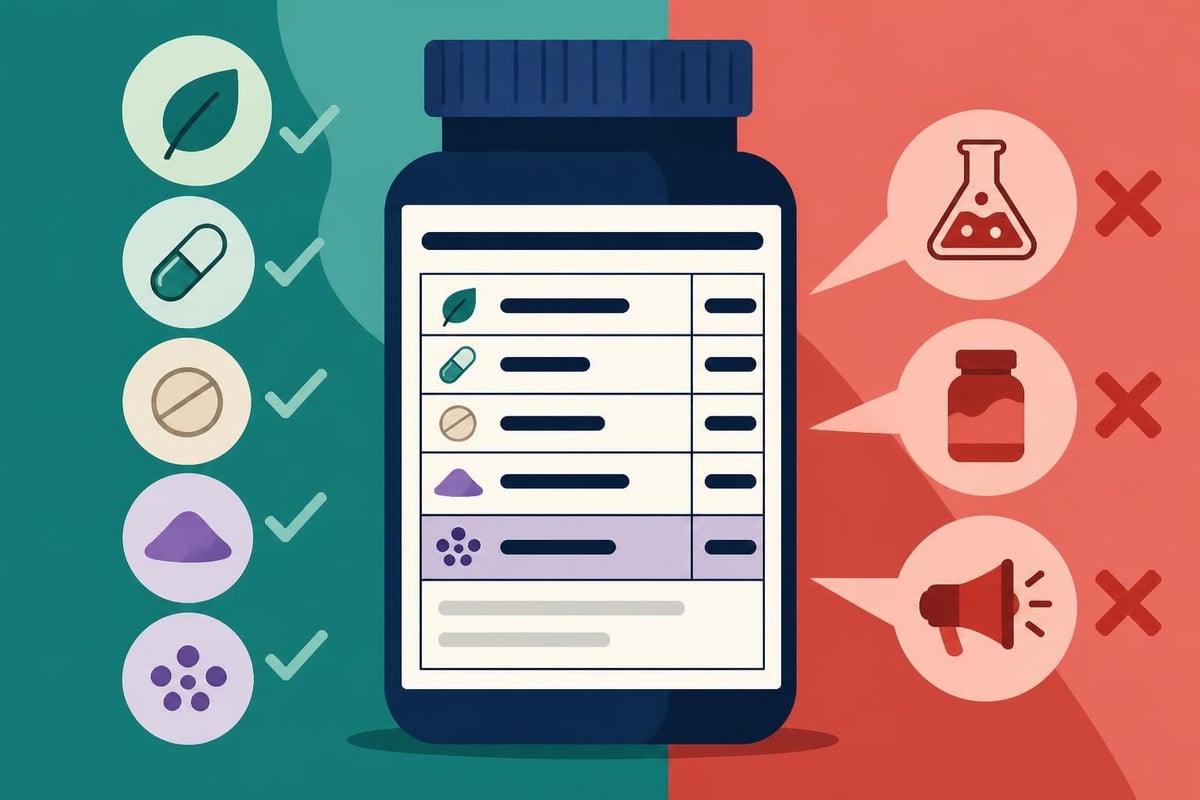
Proprietary Blends and Dose Transparency
Proprietary blends list multiple ingredients under a single total weight without disclosing individual amounts. This practice prevents you from knowing whether each component reaches effective doses. While companies claim this protects formulation secrets, it primarily obscures underdosing and makes comparison shopping impossible. The best quality supplements disclose every ingredient amount transparently.
Storage, Stability, and Expiration Considerations
Purchasing high-quality supplements means little if improper storage degrades active ingredients before consumption. Different nutrients exhibit varying stability profiles, and packaging quality directly impacts shelf life.
Storage guidelines by supplement type:
- Probiotics: Refrigeration required for most strains (unless specifically shelf-stable)
- Fish oil: Dark bottles, refrigeration after opening, consumed within 90 days
- Vitamin C: Cool, dark, dry storage; degrades rapidly when exposed to heat/moisture
- B vitamins: Generally stable, but light-protective packaging extends shelf life
- Minerals: Very stable; primarily need protection from moisture
Oxygen, light, heat, and moisture all accelerate degradation. Premium packaging includes desiccant packets, opaque or amber bottles, blister packs for individual dose protection, and nitrogen flushing to displace oxygen. These details signal a manufacturer's commitment to delivering potent products throughout shelf life.
Check expiration dates at purchase and note when bottles are opened. Many nutrients degrade faster once exposed to air, even in closed containers. Buying quantities you'll consume within 3-4 months optimizes freshness over bulk purchasing.
Building an Evaluation System
Rather than trusting marketing claims or relying on price signals, develop a systematic approach to supplement evaluation that considers multiple quality dimensions simultaneously.
Creating Your Quality Scorecard
Rank potential supplements across key criteria:
| Criterion | Weight | Brand A | Brand B | Brand C |
|---|---|---|---|---|
| Clinical evidence | 30% | Strong | Moderate | Weak |
| Dose matching research | 25% | Exact match | 80% of studied dose | Below threshold |
| Third-party testing | 20% | NSF + USP | USP only | None verified |
| Manufacturing standards | 15% | cGMP, owned facility | Contract cGMP | Unknown |
| Transparency | 10% | Complete | Good | Limited |
Assign weights based on your priorities. Someone with serious health conditions might weight evidence and safety testing most heavily, while a healthy person optimizing performance might emphasize bioavailability and dose precision.
Leveraging Decision Support Tools
Evaluating supplements across multiple quality dimensions requires significant time and expertise. Services that systematically rank products based on evidence strength, dose fit, manufacturing trust, and other factors streamline this process. Taking a quick assessment of your specific health goals can narrow thousands of options to the few supplements with strong evidence for your situation, saving hours of research while improving decision quality.
Navigating Marketing Claims and Hype
The supplement industry employs sophisticated marketing that often emphasizes emotional appeals over substantive quality indicators. Recognizing common tactics helps you focus on evidence rather than persuasion.
Common Marketing Red Flags
Be skeptical of supplements promoted through:
- Celebrity endorsements without scientific backing
- Before-and-after photos (especially for non-appearance outcomes)
- Terms like "breakthrough," "miracle," or "secret"
- Phrases like "doctors don't want you to know"
- Pressure tactics ("limited time offer")
- Testimonials as primary evidence
The best quality supplements typically market themselves through educational content, peer-reviewed research citations, and transparent quality documentation rather than emotional manipulation. If a product's marketing focuses more on the problem's severity than the solution's evidence, approach cautiously.
Understanding Industry Terminology
Familiarize yourself with terms that sound scientific but may lack substance:
- "Clinically studied": May refer to ingredients generally, not the specific product
- "Natural": Legally meaningless term without regulated definition
- "Pure": Vague without specifications about contaminants tested
- "Pharmaceutical grade": No legal definition for supplements
- "Doctor formulated": Doesn't indicate which type of doctor or their qualifications
Genuine quality indicators include specific certifications, published research on the actual product formulation, and transparent disclosure of testing methodologies and results.
Special Considerations for Specific Populations
Certain groups face unique supplement quality concerns that require additional scrutiny and specialized product selection.
Athletes and Tested Individuals
Athletes subject to anti-doping regulations need supplements certified free from banned substances. Even the best quality supplements may contain trace contaminants that trigger positive tests if not specifically screened. NSF Certified for Sport and Informed Sport certifications indicate testing for over 270 banned substances.
Contamination can occur through:
- Shared manufacturing equipment with banned substances
- Raw material cross-contamination
- Intentional but undeclared addition of performance enhancers
- Naturally occurring banned substances in herbal ingredients
Pregnant and Breastfeeding Women
Pregnancy and lactation create unique nutritional demands while simultaneously requiring extra caution about supplement safety. The best quality supplements for this population include:
- Products specifically formulated for prenatal/postnatal use
- Forms of nutrients known safe during pregnancy (e.g., methylfolate over folic acid for some)
- Avoidance of herbs and ingredients with limited pregnancy safety data
- Conservative dosing within established safe upper limits
- Third-party testing for contaminants particularly concerning during development
Always consult healthcare providers before starting supplements during pregnancy, as even high-quality products may be inappropriate for your specific situation.
Older Adults
Aging affects absorption, metabolism, and nutritional needs while increasing medication use and chronic condition prevalence. Older adults benefit from:
- Higher bioavailability forms to compensate for reduced absorption
- Products tested for interactions with common medications
- Doses calibrated for age-related changes in nutrient processing
- Easy-to-swallow formats (smaller capsules, liquids, powders)
- Clear labeling for those with vision challenges
Polypharmacy (taking multiple medications) increases interaction risks. The best quality supplements for seniors include interaction checking resources and customer service equipped to discuss medication concerns.
Identifying the best quality supplements requires evaluating products across multiple dimensions simultaneously: evidence strength, dose accuracy, manufacturing standards, third-party verification, transparency, and alignment with your specific health goals. No single indicator tells the complete quality story, but systematic assessment across these pillars separates genuinely excellent products from cleverly marketed alternatives. DoseRank simplifies this complex evaluation process by ranking supplements based on evidence, dose fit, trust, value, popularity, and availability, then matching options to your personal health objectives through a quick assessment that cuts through marketing noise to identify products most likely to deliver meaningful results.